


SecureVisio and Sycope Partnership: NDR Integration Brings Network Context Directly Into the SIEM

21.09.2026
Strategic partnership brings network depth for incident handling and better cost management.
SecureVisio and Sycope are pleased to announce their technology partnership. Two independent vendors — connected by a documented integration. Sycope brings the network side: analysis of flow-based data and metadata collected from network probes, and the alerts that come out of that visibility. SecureVisio adds the other half: correlation, business context, and analysis. Both remain deployable on-premises or in the cloud, with licensing and data retention built around cost control and digital sovereignty from the ground up.
In practice, the two platforms are wired end to end. Sycope’s alerts flow into SecureVisio automatically through a dedicated connector. And from inside an incident, an analyst can go a step further: trigger a system action that reaches back into Sycope and pulls the underlying metadata for a specific IP pair, in a ±5-minute window around the alert — delivered straight into the incident as a .csv file. The network layer isn’t just visible from SecureVisio’s side; it’s callable, on demand, exactly when a case needs it.
“Network activity is the layer some SIEM deployments never fully reach — either it doesn’t arrive at all, or it arrives in volumes nobody wants to pay to keep. Working with Sycope lets us bring it into the investigation at the moment an analyst actually needs it, narrowed to the connection and the time window that matter.
This arrives alongside SecureVisio 6.0, which introduces new AI capabilities, a multi-tenant console and high availability, with AI running on-premise. Putting Sycope’s traffic metadata next to asset criticality, user behaviour and business context gives analysts a level of depth and granularity we could not offer from logs alone — and all of it, including the AI, stays inside infrastructure the customer controls.”
Krzysztofa Gortata, CTO, SecureVisio
“I’m glad to see two Polish vendors integrating their platforms and complementing each other’s visibility into security data. This integration extends SIEM and SOAR operations with the network traffic visibility provided by Sycope.
It reveals activity that may remain beyond the reach of traditional logs, including host-to-host communication, application context and traffic history. What is particularly valuable is that analysts can retrieve the network metadata behind a specific alert directly from an incident.
For customers, this is also an opportunity to build sovereign security architectures based on integrated European technologies.”
— Piotr Kawa, VP of Sales, Sycope
Why this partnership is relevant for European businesses
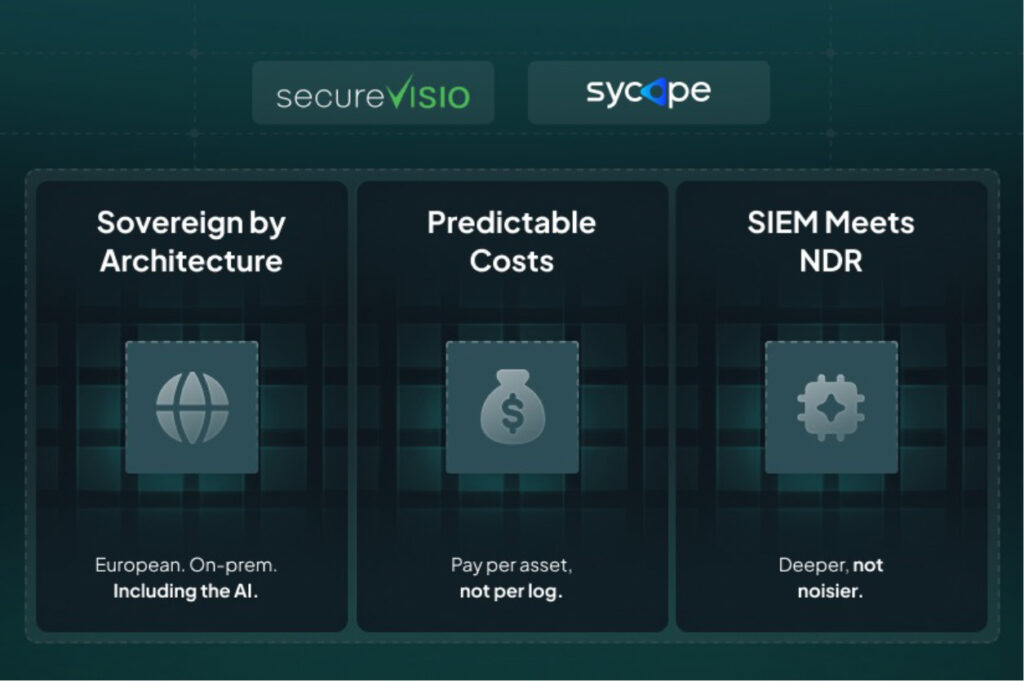
European organizations are under growing pressure to strengthen cyber resilience while maintaining greater control over their technology, infrastructure and data. The SecureVisio–Sycope partnership addresses this challenge by combining SIEM capabilities with deep network visibility and NDR context in an integrated European technology stack.
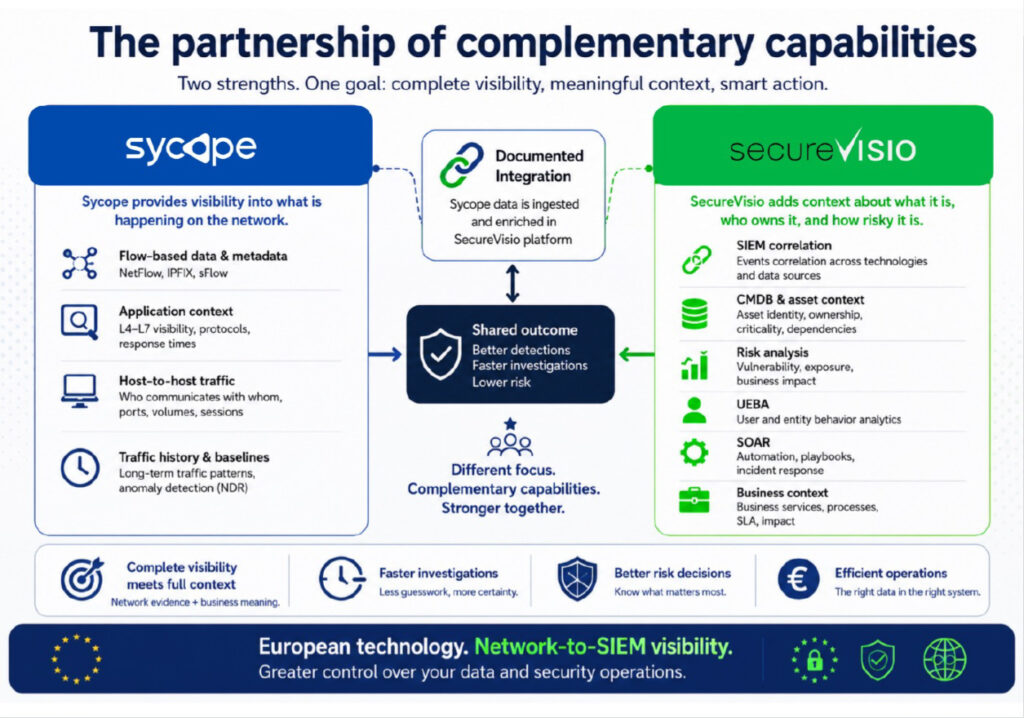
The partnership of complementary capabilities
Sycope provides standalone NDR and network monitoring capabilities, with a documented integration connecting it to the SecureVisio platform.
- Sycope supplies flow-based data and metadata collected from network probes, application context, host-to-host traffic, and traffic history.
- SecureVisio adds SIEM correlation, CMDB, risk analysis, UEBA, SOAR, and business context.
Together, this doesn’t create a new product — it creates a division of tasks: one system sees what’s happening on the network. The other knows which asset is behind it, which business process it serves, and how high the risk is there.
Why NDR and SIEM work better together, not apart
A SIEM correlates what it’s told to look at. Network traffic that never gets logged in the right format, at the right granularity, simply doesn’t exist for it. That’s the gap NDR closes — and it’s why pairing the two isn’t redundancy, it’s coverage.
Visibility the SIEM alone doesn’t have. Sycope brings network detection to the table — lateral movement, DNS tunneling, beaconing, command-and-control communication. These are behaviors that live in the traffic itself, not in a log line, and log-based correlation alone was never built to see them.
Context at the moment of investigation, not after. When an alert fires, the analyst doesn’t need to leave the incident to go pull raw traffic data from a separate console. The relevant NetFlow — filtered to the exact client-server pair, in the window around the alert — is one action away, attached directly to the case as evidence.
One correlated picture, not two separate tools. A network alert doesn’t sit in isolation. The security rule turns it into a SecureVisio event, which flows into the same SOAR automation, the same CMDB context, the same risk scoring and UEBA baselines as everything else the platform already knows about that environment.
Integration you configure, not integration you build. The connector, the parser, the detection rule, and the enrichment action ship as ready components. Turning on network context isn’t a development project — it’s activation.
How the integration works: connector, parser, rule, metadata on demand
Four building blocks that fit together:
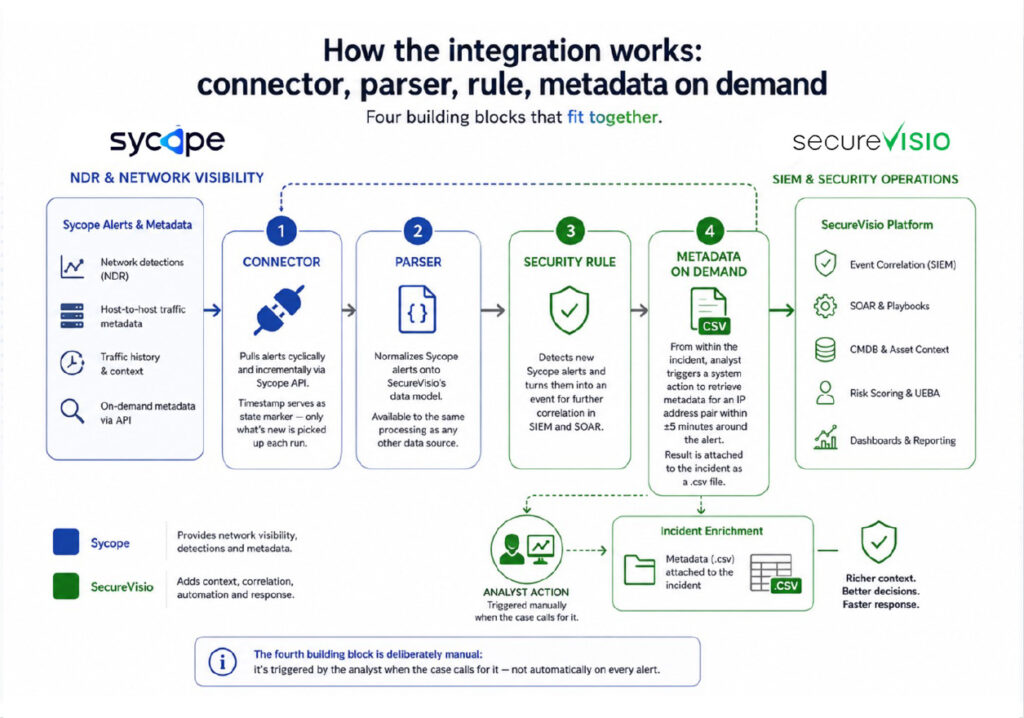
- Connector. It pulls alerts cyclically and incrementally via Sycope’s API. The timestamp serves as a state marker, so only what’s new is picked up on each run.
- Parser. It normalizes the Sycope alerts onto SecureVisio’s data model. This makes them available to the same processing as any other data source.
- Security rule. It detects new Sycope alerts and turns them into an event for further correlation in SIEM and SOAR.
- Metadata on demand. From within the incident, the analyst triggers a system action that retrieves the metadata for an IP address pair within a window of ±5 minutes around the alert. The result is attached to the incident as a .csv file.
The fourth building block is deliberately manual: it’s triggered by the analyst when the case calls for it — not automatically on every alert.
A case from everyday work: investigation without switching tools
A network alert reaches the SIEM and becomes an event that gets correlated with everything else the platform sees. The analyst opens the incident and already has the context assembled: the affected asset, its role in the business process, the risk involved, the behavior of the accounts in question.
What was missing until now was the network layer underneath — who talked to whom, over what period, over which application. That’s exactly what the analyst now pulls in at the same spot where the case already sits: one click, the time window around the alert, the traffic data attached to the incident. No second tool, no second login, no manually piecing together timestamps across consoles.
What the added network context does to your licensing costs
Before additional network data moves into incident handling, there’s a question that isn’t technical: what does this do to processing — and what does it do to the license? The answer partly determines how deep an investigation is even allowed to go. Here it gets answered three times, at three different points, before it can become a cost.
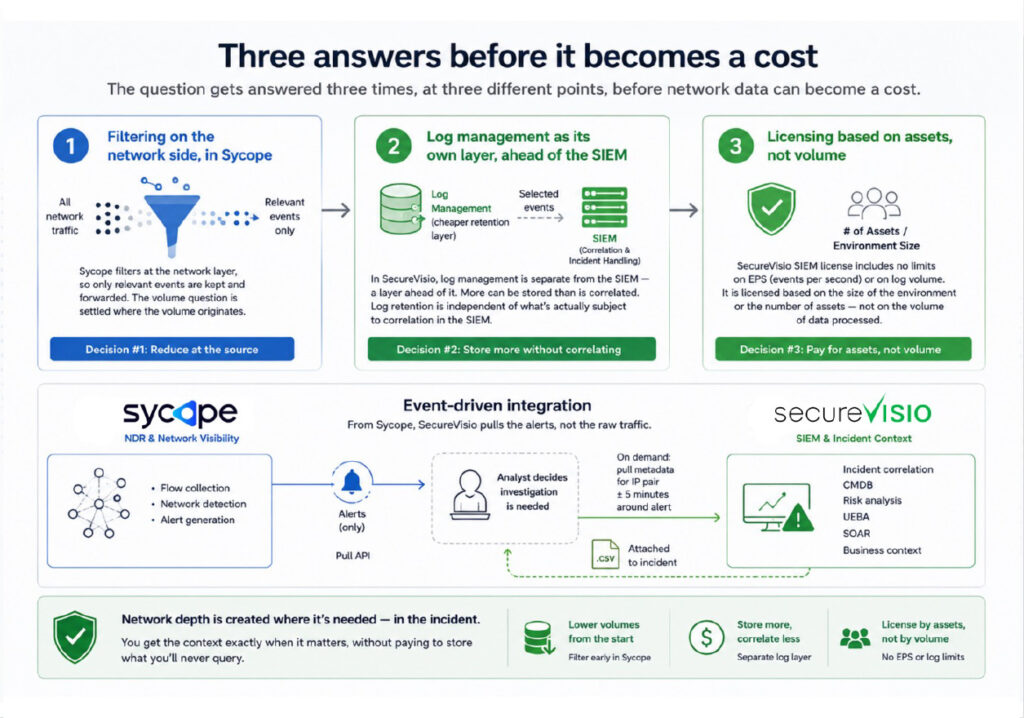
Filtering on the network side, in Sycope. Not all traffic has to become a record. Sycope filters at the network layer, so what it holds and forwards is already reduced to what’s relevant — the volume question is settled where the volume originates, rather than passed downstream.
Log management as its own layer, ahead of the SIEM. In SecureVisio, log management is separate from the SIEM — not a stage within SIEM processing, but a layer ahead of it. This separation allows for cheaper data retention without routing all data through SIEM processing. More can be stored than is correlated, and log retention is independent of what’s actually subject to correlation in the SIEM. That’s the difference between having data and sending data through correlation. With SecureVisio, the two aren’t the same.
Licensing based on assets, not volume. The SecureVisio SIEM license includes no limits on EPS (events per second) or on log volume. The platform is licensed based on the size of the environment or the number of assets — not on the volume of data processed.
On top of those three, the integration itself is event-driven, not a continuous stream. From Sycope, SecureVisio pulls the alerts, not the raw traffic. Network data doesn’t flow into the SIEM by default and sit there running up ingestion costs whether anyone looks at it or not. It’s pulled — precisely, for the pair of addresses involved, in the window around the alert — only when an analyst decides it’s needed. Network depth is created where it’s needed, in the incident, without the entire traffic history first having to run through correlation. You get the context exactly when it matters, without paying to store what you’ll never query.
On-premises on both sides: where the data stays
Both systems can be operated on-premises. For organizations that want to keep their security data in their own data center, or that must for governance reasons, this is the property an extension would otherwise fail on: neither the network alerts nor the retrieved traffic data need to leave your own infrastructure. No requirement to route network telemetry through infrastructure you don’t control to get the visibility you need. For SecureVisio, operation as an EU private cloud is also available.
Want to see what this looks like in your environment? Schedule a call.
Strategic partnership brings network depth for incident handling and better cost management.Why this partnership is relevant for European businessesThe partnership of complementary capabilitiesWhy NDR and SIEM work better together, not apartHow the integration works: connector, parser, rule, metadata on demandA case from everyday work: investigation without switching toolsWhat the added network context does to your licensing costsOn-premises on both sides: where the data stays


