


AI in SecureVisio 6.0: How Machine Learning, LLMs, and Deep Value Learning Are Transforming Security Operations

08.04.2026
SecureVisio 6.0 introduces a powerful, multi-layered artificial intelligence engine that fundamentally changes how security teams detect threats, respond to incidents, and automate their SOC operations. This is the second article in our SecureVisio 6.0 series. The first piece covered what’s new in the web application. Upcoming articles will explore significant performance improvements, expanded SIEM and SOAR capabilities, and major CMDB and UEBA engine enhancements. This article focuses exclusively on the AI advancements built into SecureVisio 6.0.
Why AI in SIEM/SOAR Is No Longer Optional
Security operations centers face a relentless flood of events, alerts, and log data. Human analysts simply cannot process it all at the speed modern threats demand. SecureVisio 6.0 was built around a clear answer to this challenge: intelligent, layered automation that thinks before it acts — and gets smarter over time.
Four AI Methods Working Together in SecureVisio 6.0
SecureVisio 6.0 stacks four distinct AI techniques into a single, coordinated engine:
1. Machine Learning (ML) The foundation. Machine learning models analyze behavioral patterns across all incoming data — detecting anomalies, learning what “normal” looks like for each environment, and flagging deviations in real time.
2. Deep Value Learning A major new addition in version 6.0. Deep Value learning enables the system to learn the value of specific behaviors and processes — for example, which processes launch other processes, which network connections are typical for a given host, or which user actions are associated with which geographic locations. This gives SecureVisio a deep contextual understanding of your environment, not just surface-level pattern matching.
3. Large Language Models (LLMs) LLMs in SecureVisio 6.0 serve as the system’s analytical voice. They summarize incidents, explain what happened in plain language, generate search queries for threat hunting, and help analysts understand complex log data without requiring deep technical expertise.
4. Large Reasoning Models (LRMs) Where LLMs summarize, LRMs decide. Large Reasoning Models are used for the highest-stakes analytical tasks: evaluating whether a situation warrants deeper investigation and determining the next best action in an automated playbook. Because LRMs require more processing time, SecureVisio uses them selectively — only after ML and value learning have already filtered and prioritized the data.
How the AI Layers Work in Sequence
SecureVisio 6.0 doesn’t throw every AI method at every event. Instead, it works through a deliberate, tiered pipeline designed for both speed and accuracy:
- Machine learning runs first — detecting anomalies across thousands of events per second without delay.
- Deep Value learning evaluates whether expected behaviors occurred and flags missing or unexpected activity (predictive value analysis).
- LLM analysis is applied next — summarizing the situation and generating investigative queries.
- LRM reasoning kicks in last — only when the situation is complex enough to warrant it — to decide what action the playbook should take next.
This staged approach ensures that expensive, time-consuming AI reasoning is reserved for situations that genuinely require it, keeping performance high even at enterprise scale.
AI-Powered Playbooks: From Static Scenarios to Dynamic Decision-Making
One of the most significant shifts in SecureVisio 6.0 is the deep integration of AI with playbooks. Where previous versions relied on static, condition-based scenarios, version 6.0 allows AI to actively steer playbook execution.
In practice, this means:
- A playbook step can include an AI Request — asking the AI to evaluate the situation and make a decision.
- The AI’s response is stored in a variable, and the playbook branches based on what the AI concludes.
- If the AI determines that malicious files are likely present, the playbook proceeds to hash verification and deep file analysis. If not, it skips those steps — saving time and resources.
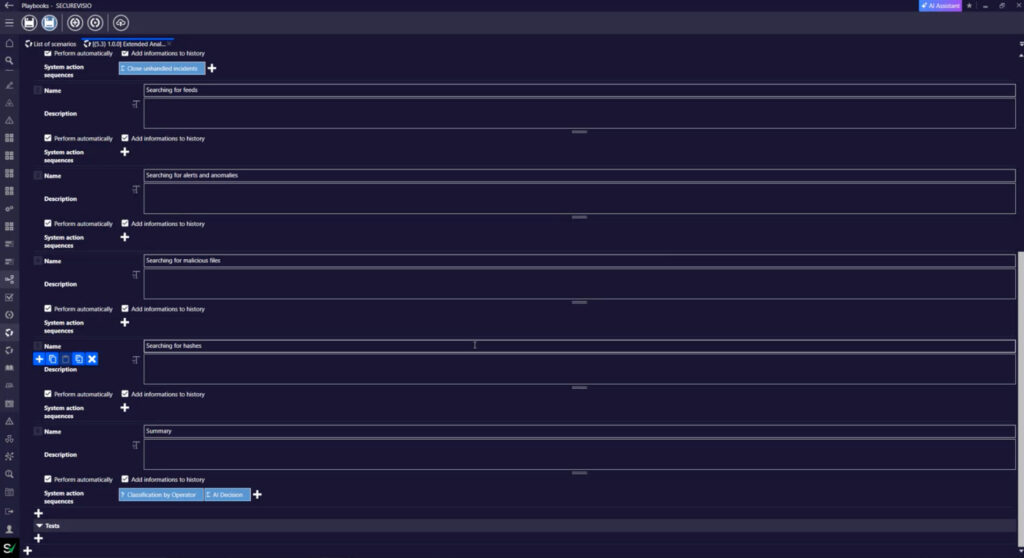
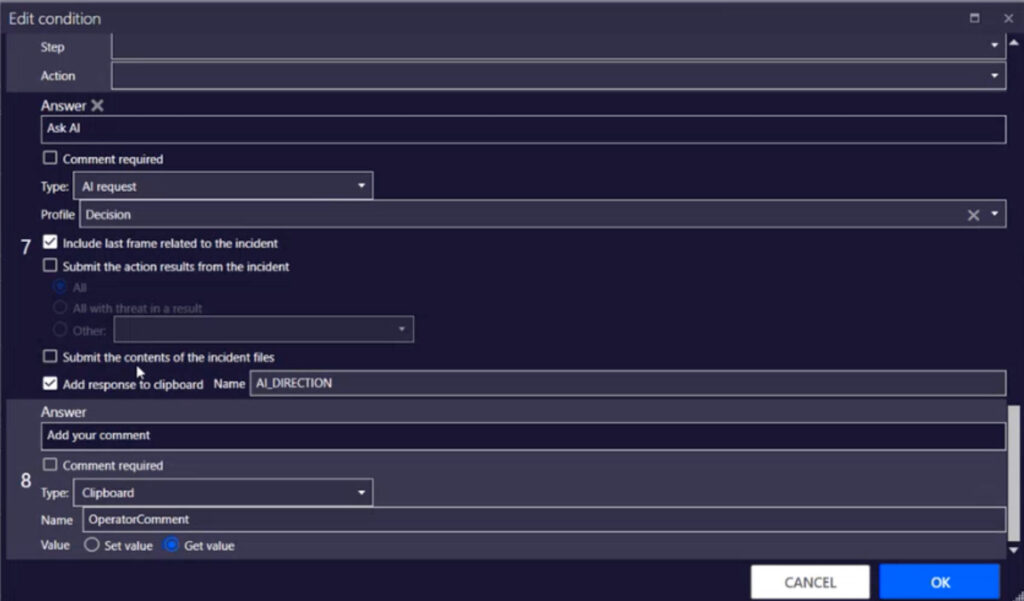
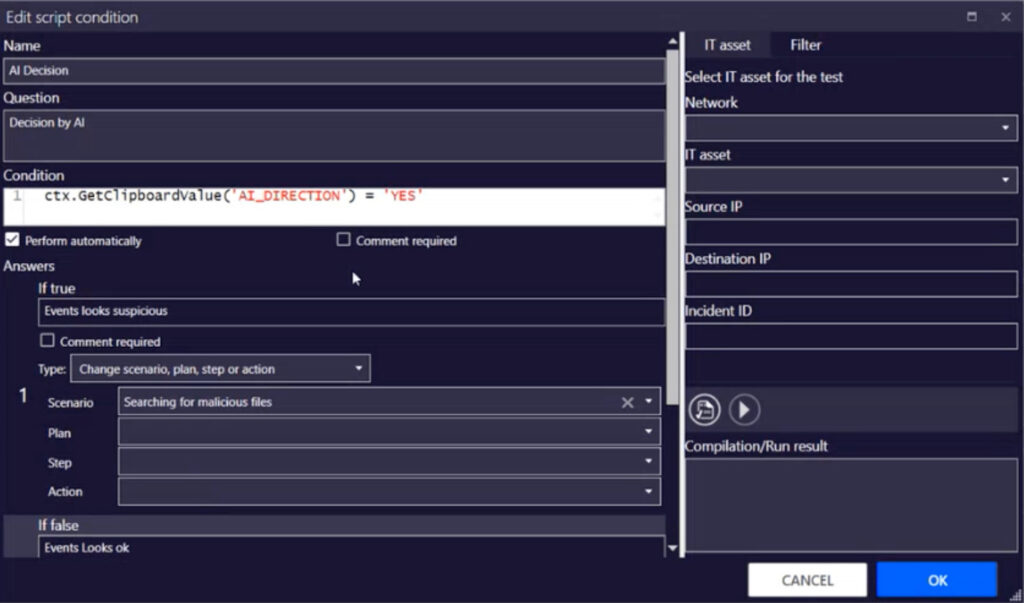
This eliminates the need for dozens of pre-written static scenarios. SecureVisio has always operated with a single, unified scenario model — now that scenario is guided dynamically by AI reasoning rather than rigid pre-set conditions.
AI-Assisted Threat Hunting and Log Analysis
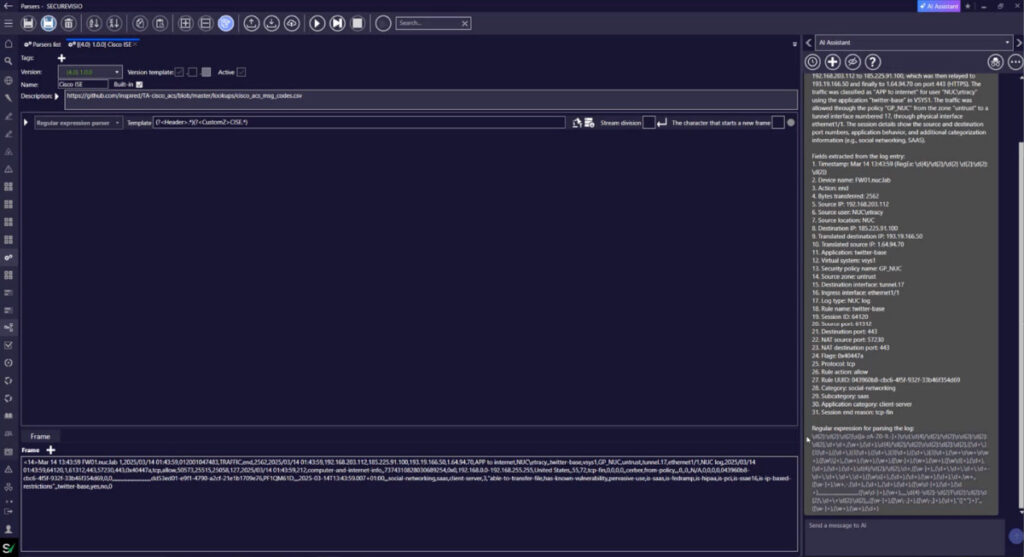
SecureVisio 6.0 brings AI directly into the hands of analysts through a persistent AI Assistant available throughout the entire interface. The assistant is context-aware: if you are working in the log parser, the assistant knows it and tailors its help to parsing tasks. If you are reviewing an alert, it analyzes that specific event.
Key capabilities include:
- Incident summarization — the AI explains what happened in a security event in clear, plain language.
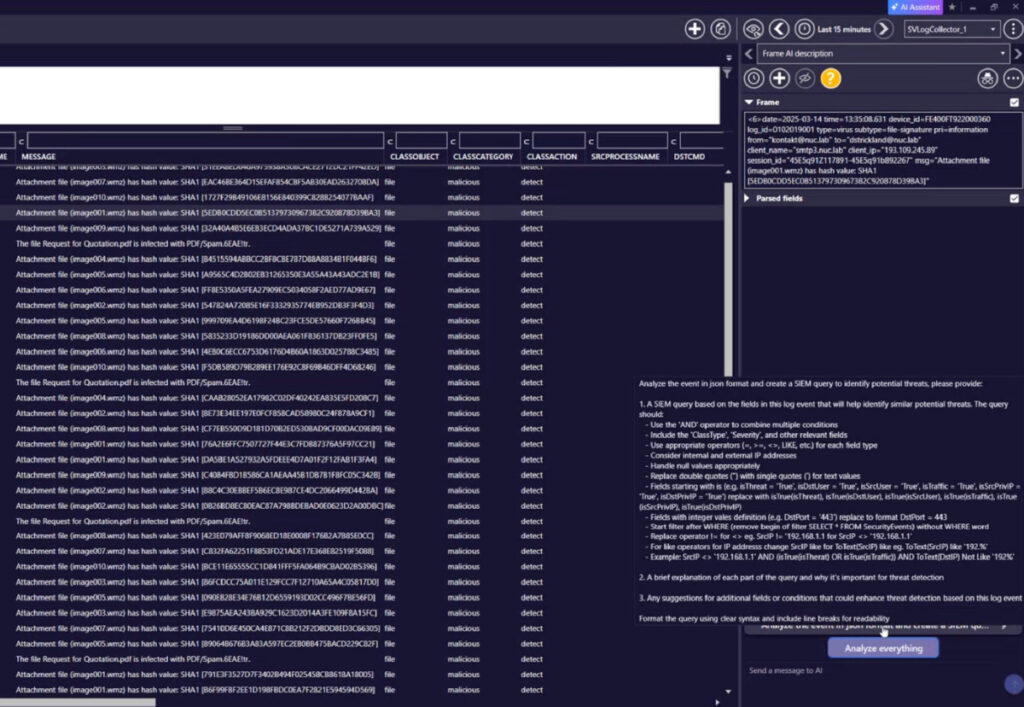
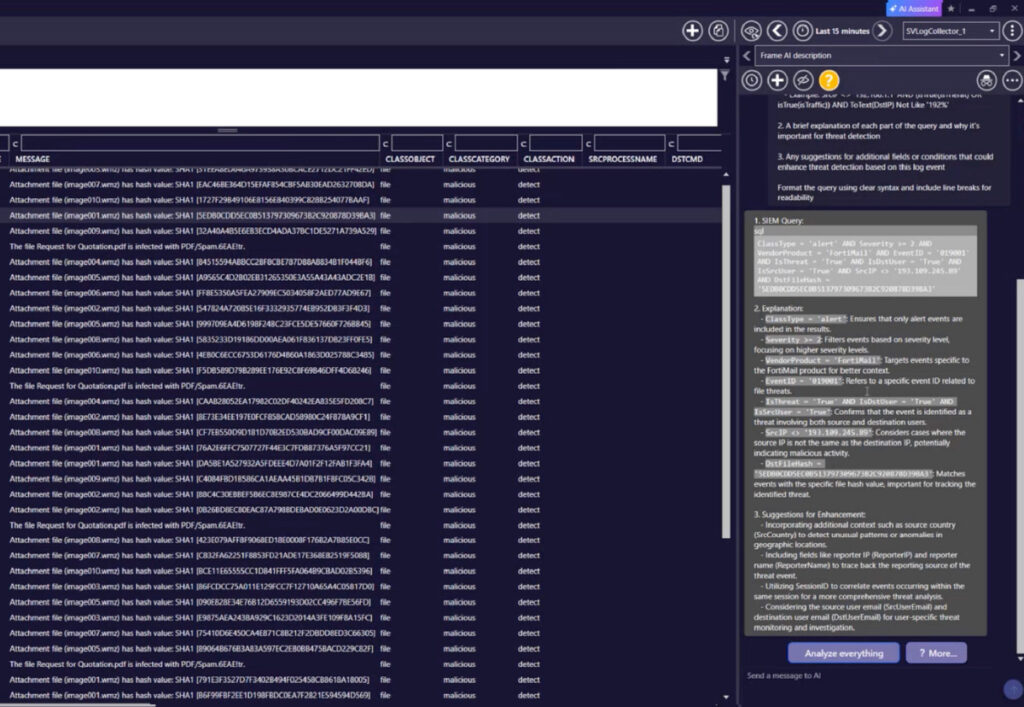
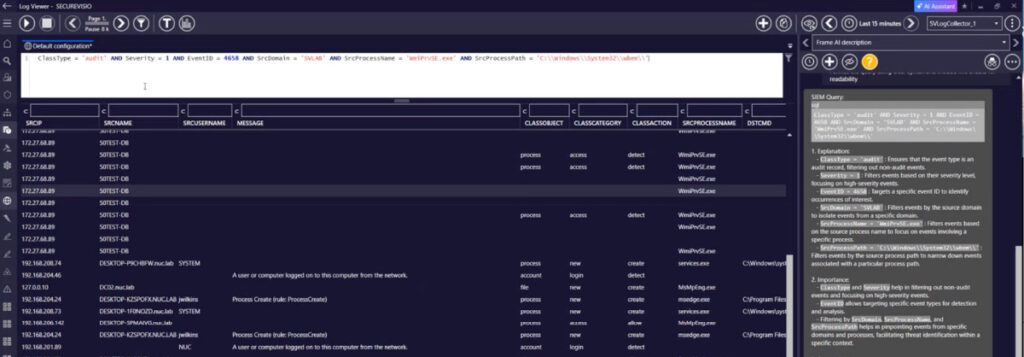
- Search query generation — analysts can ask the AI to write search queries for finding similar events or related indicators across the log database, dramatically lowering the barrier for threat hunting; these queries can then be quickly copied and pasted into the log viewer for immediate use.
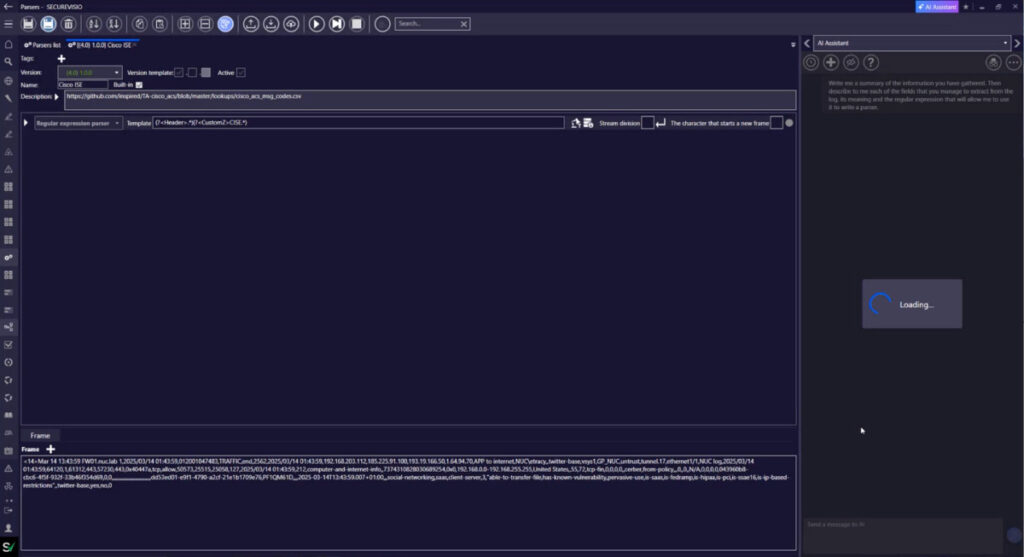
- Log parsing assistance — the AI can analyze raw log samples and generate parser configurations, reducing one of the most tedious parts of SIEM onboarding.
Deep Value Learning: Teaching the System What Matters
Deep Value learning deserves special attention because it represents a new dimension of intelligence beyond traditional anomaly detection.
In SecureVisio 6.0, administrators can define what the system should learn values around. For example:
- Which countries users are connecting from (source context)
- Which assets are being accessed and by whom (destination context)
- Which processes are spawning other processes (process activity)
- Which user actions are associated with which categories of behavior
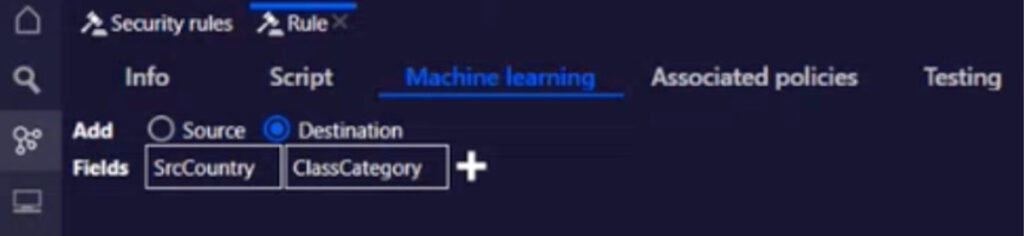
This customizable learning scope means SecureVisio adapts its intelligence to the specific risk profile of each organization — learning what is normal for you, not just what is statistically average across all environments.
Flexible Model Support: Local and External AI
SecureVisio 6.0 supports both internal (on-premise) AI models and external AI services. Organizations with strict data residency or confidentiality requirements can run their own local AI server — keeping all data within their infrastructure. For organizations that prefer cloud-based AI, external model integrations are also supported.
When sending data to external models, SecureVisio automatically anonymizes sensitive fields before transmission, ensuring that no confidential organizational data is exposed to third-party services. Additionally, users can control which data fields are anonymized, allowing for flexible and customizable data protection.
Automated Context Building: Smarter CMDB in Version 6.0
In SecureVisio 5.0, asset context was limited to what could be derived from security policy rules. Version 6.0 introduces automated playbooks for context building — continuously searching for and updating asset information without requiring manual input.
Actions like Change Asset Parameter Value allow playbooks to classify and enrich assets automatically over time. The system can confirm asset attributes on its own — or ask an operator to verify — and if no response is received, proceed with its own determination. The result is a living, self-updating CMDB that grows more accurate the longer the system runs.
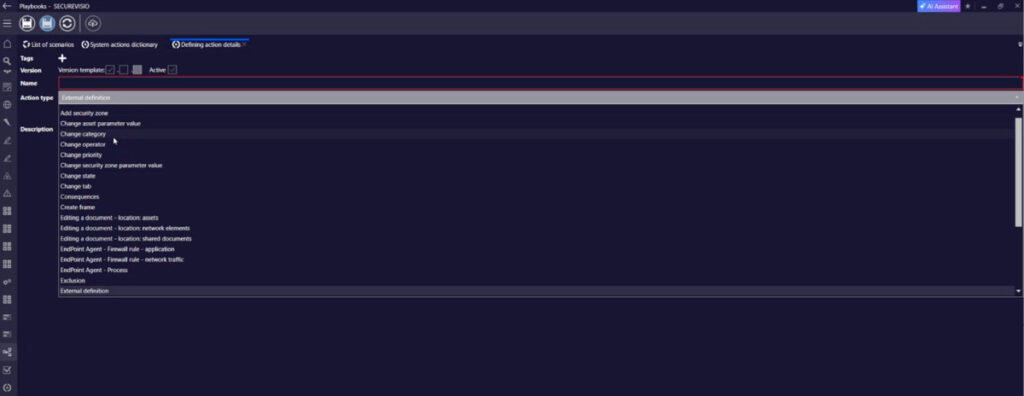

Context detection effectiveness in version 6.0 is not an incremental improvement — it represents a step-change in how thoroughly and automatically the system understands your environment.
Self-Tuning: Automatic Noise Reduction
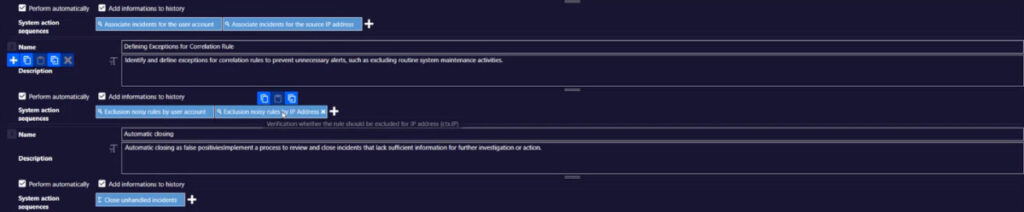
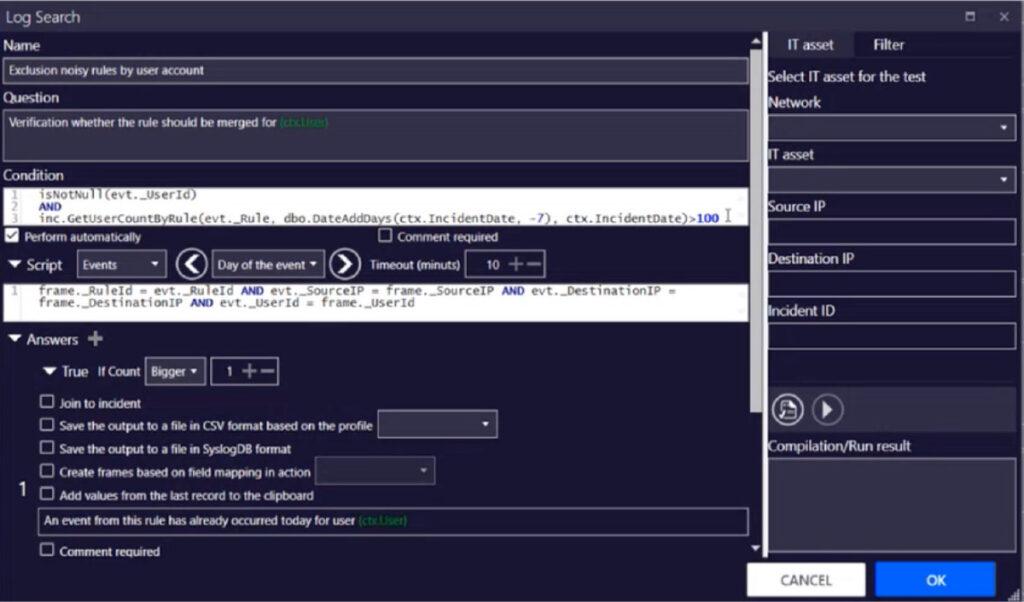
One of the most common challenges in any SIEM deployment is alert fatigue — policies that generate too many false positives for a specific host or IP address. SecureVisio 6.0 addresses this with automatic triage and exclusion rules.
The system monitors rule firing statistics. If a policy generates excessive noise for a specific IP address or user account, it automatically creates an exclusion rule — the same fine-tuning task that previously required manual operator intervention. This self-tuning capability significantly reduces the time and expertise required during deployment and ongoing operations.
Automatic Parser and Policy Selection
Version 6.0 also eliminates one of the most time-consuming steps in SIEM onboarding: manually assigning parsers and policies to new log sources. When a new log is forwarded to SecureVisio, the system now automatically selects the best matching parser and applies an appropriate global policy — with no manual configuration required.
This capability is a cornerstone of SecureVisio’s goal to dramatically reduce deployment time, with a stated target of bringing typical deployment from three months down to two weeks — and eventually enabling systems to largely configure themselves.
Unlimited Custom Profiles in UEBA
A practical but important improvement: UEBA in SecureVisio 5.0 was limited to 10 profiles. Version 6.0 removes this limitation entirely, allowing organizations to define as many custom profiles as needed. Profiles can also be individually deactivated or excluded from machine learning — giving administrators precise control over what the system learns and from which sources.
What This Means for Security Teams
The cumulative effect of these AI improvements is a platform that:
- Reduces manual workload across detection, investigation, response, and tuning
- Lowers the skill barrier for threat hunting and log analysis through AI-assisted querying
- Improves detection accuracy through layered, context-aware intelligence
- Automates the full incident response lifecycle — from anomaly detection through playbook-driven remediation
- Continuously improves as it learns the specific patterns of each environment
SecureVisio 6.0 does not replace security analysts. It amplifies them — handling the repetitive, time-consuming work so that human expertise can be focused where it matters most.
Conclusion
SecureVisio 6.0 represents a genuine leap forward in what an AI-powered SIEM/SOAR platform can do. By combining machine learning, Deep Value learning, LLMs, and LRMs into a single coordinated system —
By integrating AI deeply into playbooks, context building, and self-tuning — SecureVisio delivers an automation capability that goes far beyond rule-based alerting.
For organizations facing resource constraints, growing threat complexity, or the challenge of managing large-scale security operations, version 6.0 offers a compelling answer: intelligent security automation that learns, decides, and acts — at machine speed.


